Lead Review
- Book: The Illogic of Kassel
- Location: Kassel
- Author: Enrique Vila-Matas
3.5*
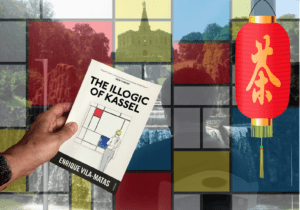 I was looking forward to reading this novel, novella almost, because I had spent a month working at the German Wallpaper Museum (definitely worth a visit!), in Kassel and also visited the Documenta that happened to on at the time. So I was naturally curious to see what an author would make of this avant-garde art show, with its installations and art objects which populate the city for 3 months every 5 years. As our protagonist in the novel moots: “Behind the legend of Kassel, is the legend of the avant-garde“.
The writer in the novel is invited to come from his home town of Barcelona to spend some time sitting, writing in the Chinese Restaurant, Dschingis Khan, in the backwaters of the town. A living installation, as it were. He is escorted and shepherded by various members of the Documents team around the city, examining the art installations, and as he wanders, he gets lost, and finds himself again, he notes that his regular evening gloom begins to lift, inspired as he is by the interactions, sights and visions all around him.
The narrative is written in a surreal (at times humorous) way that is reminiscent of the plaques written at art shows, to help explain the paintings and what you are seeing and experiencing. Yes, it aims to reconstruct a disarticulated discourse, if that makes any sense to you, the clue for the kind of narrative lies distinctly in the title of the book. The text can be interesting, discursive, as the protagonist ponders each new manifestation. It can also be pompous and pretentious like some of the artworks, and laboured, too, but this may in part be the translation, which, as it happens, is clearly aimed at the American market. Little giveaways like “When I arrived at the Frankfurt Airport” (what’s that little “the” doing there?) can give it a slightly jarring and stilted style.
But of course you wouldn’t dare hang an ordinary canvas painting at Documenta, too plebeian by far. As you read, you will discover a variety of amazing artworks in the 2012 exhibition, from the sculpture of a woman who has a beehive as a head, to the sonorous installations at the train station. And returning time and again to the Fridericianum (the oldest public museum in Europe, by the way) which is the “temple of the Documenta“.
Kassel is, though, at the heart of the novel, as the author records to the sights and sounds moving around the city. One installation includes a reference to loot pilfered from Hitler’s Austrian mountaintop house, which in turn leads the protagonist off to ponder what it must have been like at the Berghof in the Alps, now flattened and covered in grass. This seemed an easy excuse to slide off topic once again to the Nazi era and labour the point of Germany’s oftentimes difficult history.
The author in the book stays at the Hotel Hessenland (now a Days inn), a 50s style hotel in the city, and wanders the Auepark in the city, gets lost in the centre, finds his reference points and ponders some more. A generally interesting book that probably won’t have wide appeal. Part of me hopes, however, that the Documenta team has seen fit to make this novel available on site – now that would be perfect in terms of TripFiction!
 Please wait...