Lead Review (By Any Other Name)
- Book: By Any Other Name
- Location: England, Manhattan
- Author: Jodi Picoult
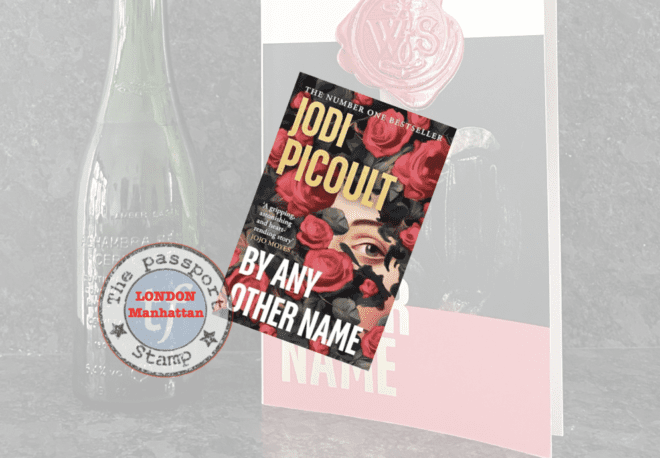
“..to be successful as a woman, one would have to be invisible..” (Mary Sidney). That is this story in a nutshell.
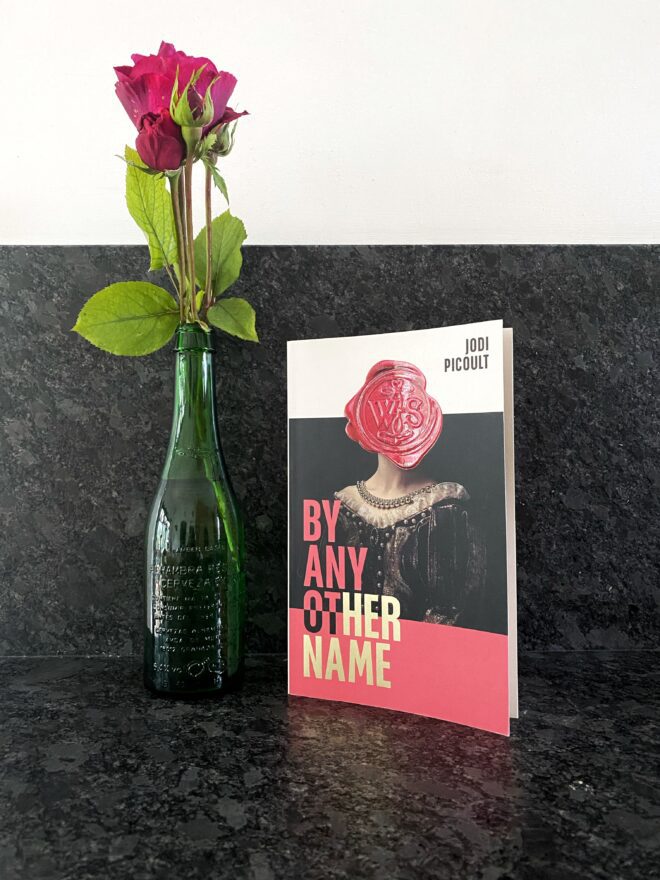
First off, though, let’s acknowledge the extremely beautiful book cover!
Back in the late 16th Century/early 17th Century, Emilia Bassano is a sassy young woman who is a gifted playwright. She is partnered off with the already married Lord Chamberlain – Hunsdon, whose remit it is, in part, to oversee plays staged in public. This is a fortuitous bonus and coincidence because Emilia comes into contact with all kinds of writers, like Marlowe and Shakespeare. And this is the premise of the novel, posing the question: Was a female skilled writer actually behind the works of the likes of Shakespeare?
 In the present Melinda Green – Emilia’s very distant relation – is making ends meet as best she can whilst working on playwriting in New York. In her early days, theatre critic Jasper Tolle gave her a real comeuppance, judging her work to be pretty abysmal. Several years later her play has been submitted for a competition, which is unfortunately due to be judged by the very same man. Will he remember her..?
Unbeknownst to her, her play had been submitted for this competition by her pal and flatmate Andre, who is now having to pretend to be her – ‘Mel’ after all, as a name, is unisex. I guess we must overlook the absence of any Social Media reference to Mel, who surely would have some accounts demonstrating clearly that her male manifestation is a fraud? Anyway, let’s gloss over that..
You can really hear the pleasure the author has had in researching the older story and much of the historic detail feels accurate and colourfully portrayed. But there is an overlay of modern thinking which doesn’t chime so well: “The first death in London from plague.. ‘ – I am sure a single death is not how the plague years opened in the later 16th Century. And Amelia’s opportunistic lover, Southampton, wouldn’t have had the benefit of psychological insight (Freud after all only pioneered the concept at the turn of the 20th Century). Thus, it feels rather far-fetched that the complexities of his psyche might derive from the poor example his parents set in the way they managed their couple relationship. Colour pops? … Hmmm. Elements such as these feel too blatant and diminish the authenticity of the historical story.
The older story forms the bulk of the book and the modern story underlines that two women essentially face the same challenges, even though their lives are 500 years apart – this message is driven home with relentless vigour. This is an author who excels at bringing the bigger social issues to her readers but I feel that historical storytelling isn’t ultimately her forte, especially when there are already consummate authors like Tracy Chevalier (The Glassmaker) and Maggie O’Farrell, whose novel Hamnet convincingly looks at the life of Shakespeare.
There is a diverting exercise in the novel. Copious Shakespearean quotes pepper the narrative and at the end the reader can look up where they each appeared. Surprisingly, there is no scoring system, which might have been fitting given the nature of this novel.
And goodness, it is a long read and I am sure a firmer editing hand could have curtailed the length. I concur with the Guardian’s review: “Had this novel’s 500-plus pages been ruthlessly edited, it might have been a diverting romp.”
 Please wait...