Historical novel set around ENGLAND (Birmingham)
Talking Location With … Stephen Chance: NEW YORK
29th January 2026
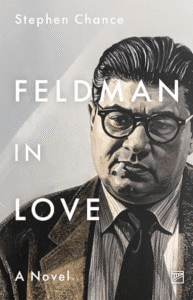 #TalkingLocationWith… Stephen Chance, author of Feldman in Love, set in NEW YORK
In my novel Feldman in Love the main character, Morton Feldman, is based on a real person who lived in New York from 1926 until 1987. The novel opens in 1950 with my character walking in the city’s Lower East Side, on his way to a crucial meeting.
I made a research trip to New York arriving on the 12th of January – which turned out to be Feldman’s birthday. Next year will mark the centenary of his birth.
I’d located myself in the area around Saint Mark’s Place, the epicentre of Feldman’s life, which he referred to in his collection of essays: Give My Regards to Eighth Street.
I followed Feldman’s footsteps into the Lower East Side, down past Essex Street Market and into the area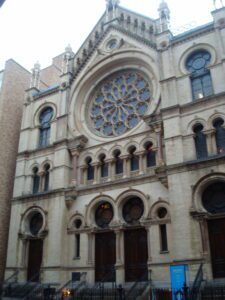 which in his day was predominantly East European immigrants working in the garment business, the rag trade. Living in crowded tenements where they also worked, they sold their wares from street stalls and handcarts.
A good place to understand this history, through the Bohemian period of the 50s and 60s, when artists and poets moved in to rent cheap studio space, up to the somewhat chic East Village of today, is the Tenement Museum. If you rent an apartment for your stay in this area, you’ll probably be staying in a former tenement that would once have held a family of 14 people who were also working in the same space. The Tenement Museum is a must – it’s not grim at all as an experience, and the history of the area told there is fascinating.
On your way back to the more gentrified part of the East Village you’ll come across the Bowery district. For decades Bowery was synonymous with ‘bums’ or ‘down and outs’ – what we would now call homeless people. They were still apparent when I was in New York and the district featured several wholesale kitchen catering equipment stores. However, there are also contemporary art galleries including the New Museum of Contemporary Art at 235 Bowery by architects Sanaa. It is a striking building of perforated metal boxes and bands of glass, teetering beside two older Bowery warehouses.
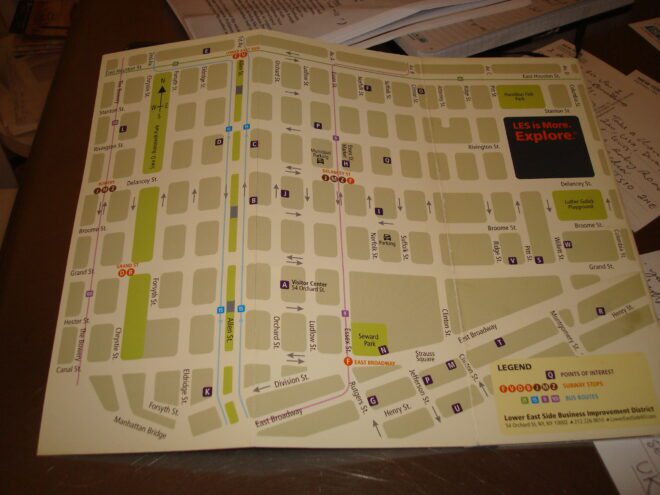
The Bowery still had an elevated railway running down the middle of the street in Feldman’s time, but now you can get up on the High Line that starts on the west side of Manhattan and walk on a different part of the old elevated railway system, now a popular, elevated park.
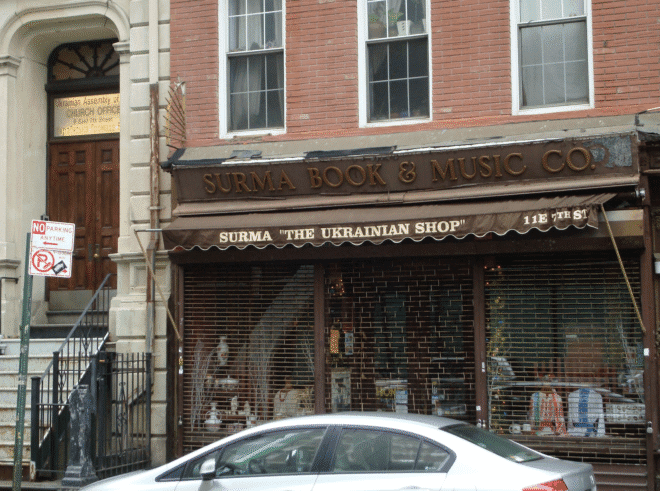
Feldman‘s family were descended from people living in Ukraine, and part of the East Village is now branded as Little Ukraine. The restaurant Veselka, which opened in 1954, is still thriving and has, since the Russian invasion of their country, become a rallying point for Ukrainians in the city. And for them and visitors alike, this is a good place to sample the traditional fare.
It would be remiss not to mention the numbers of artists and musicians who have lived in this part of New York, evidence of which you can still see. For example, the plaque for George Gershwin near the excellent Sri Lankan restaurant Sigiri, on First Avenue between East Fifth and East Sixth Street. Gershwin grew up in the Lower East Side at 91 Second Avenue. Jazz saxophonist Charlie Parker lived at 151 Avenue B, just across from Tompkins Square Park, from 1950 to 1954 and a current music venue on the west side of the Village is Le Poisson Rouge – formerly the Village Gate – where in January you can pick up the Winter Jazz Fest.
Of course, a number of artists had studios in this neighbourhood including Robert Rauschenberg and Morton Feldman’s great friend, Philip Guston.
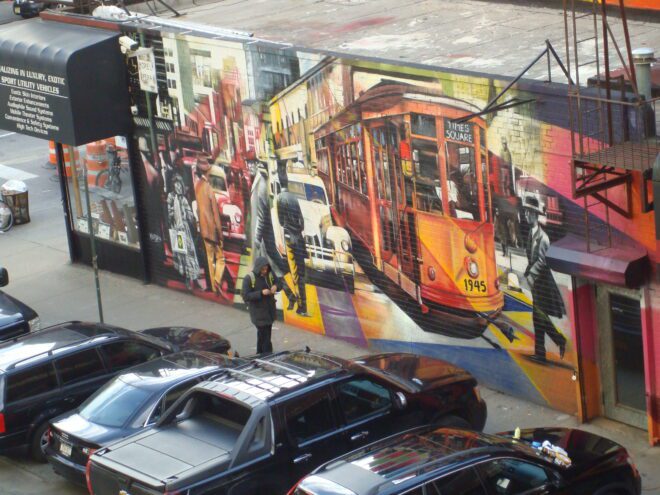
What’s nice about this part of New York is that is partly-protected from development as a historic area, so that quite a lot of the feel of the place remains; buildings of characteristic red brick and metal fire escapes, and aluminium water tanks on the roofs, still evoke the era when Feldman would have been strolling down these streets some 75 years earlier.
Feldman’s walks would also skirt Little Italy and Chinatown when he crossed Canal Street and passed the Manhattan Bridge Approach looking for where John Cage, Merce Cunningham and he lived on Monroe Street. You’ll see the Daily Forward building, a Jewish newspaper with a socialist emphasis – now luxury apartments. Carvings of Karl Marx and Friedrich Engels and a Hebrew inscription adorn the facade. And, as a reader, you might want to drop in to the McNally Jackson bookshop on Prince Street.
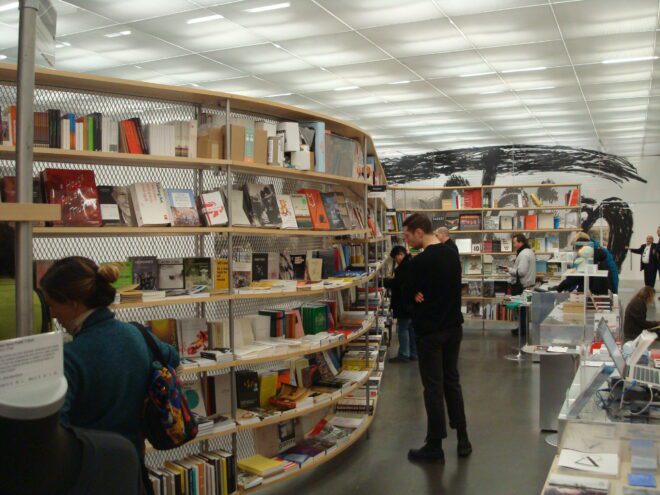
If you’re self-catering, then a good stop is the Essex Market, on Essex Street and Delancey, which has been in existence for about 100 years. It was still in its 1930s brick building when I was researching Feldman in Love, but it’s now continuing its traditional activity in a new building.
After all this you’ll have worked up a thirst, so quench it at MacSorley’s Old Ale House.
Stephen Chance
Photos: courtesy © Stephen Chance
Join team TripFiction on Social Media:
Twitter (@TripFiction), Facebook (@TripFiction.Literarywanderlust), YouTube (TripFiction #Literarywanderlust), Instagram (@TripFiction) and Pinterest (@TripFiction) and BlueSky(tripfiction.bsky.social) and Threads (@tripfiction)
 Please wait...