Mystery set in AUSTRALIA
Talking Location With … Kat Gordon: ICELAND
26th February 2026
 #TalkingLocationWith … Kat Gordon, author of The Swell (
I already had the bones of my story by the time I came across the Bárđur Saga. I knew there would be a storyline set in Reykjavik in 1975, and another set in a more remote part of Iceland in 1910, where two sisters would take in the lone survivor of a shipwreck, and I knew that the two storylines would intersect through a shared family line.
It felt very important to get the setting just right, not only because I was writing about a place I loved, but also because the Icelandic landscape is so otherworldly and unique that it feeds into the country’s literary tradition, their sagas and fairytales and ghost stories could only happen there, and I wanted to make full use of that aspect.
With the 1975 setting, having lived in Reykjavik, I felt confident I would be able to describe its downtown area; in fact it was one of the first things that struck me about the city. Growing up in London, I was used to tall, narrow houses in London stock brick, and the grander architecture and wide roads of the centre. In Reykjavik, even though we lived in the centre, it was in a maze of streets of low, gabled houses, clad in brightly painted corrugated iron, with little, rugged gardens about them, and views across the bay to the Esjan mountain range. It felt both older and newer than London in some ways, but, crucially, it felt knowable. This would be the manifestly human world – of cafes and homework and female friendships – in juxtaposition with the stormy, enigmatic world of the 1910 storyline, which is bookended with a shipwreck and a snowstorm.
When it came to the setting for the latter I was less sure. Given the shipwreck, it had to be on the coast, but we had only taken a few trips out of the city, and mostly to the interior. I asked my Icelandic friends for a part of the country that would have its own, distinct regional character and a coastline, which was how I came to hear about Snæfellsnes. It’s a peninsula to the north-west of Reykjavik, and has so many examples of the natural wonders found on the island it’s sometimes called “Iceland in miniature”. There’s a waterfall – Kirkjufelssfoss – and solitary mountain, Kirkjufell (church mountain). There are columnar basalt cliffs at Arnastapi, sea stacks, lava fields, and – most importantly for my story – Snæfellsjökull, a stratovolcano capped with a glacier. Reading about the latter, I came across several references to it as one of Earth’s “chakras”. Supposedly teeming with magnetic energy, lots of people report trouble sleeping after visiting it.
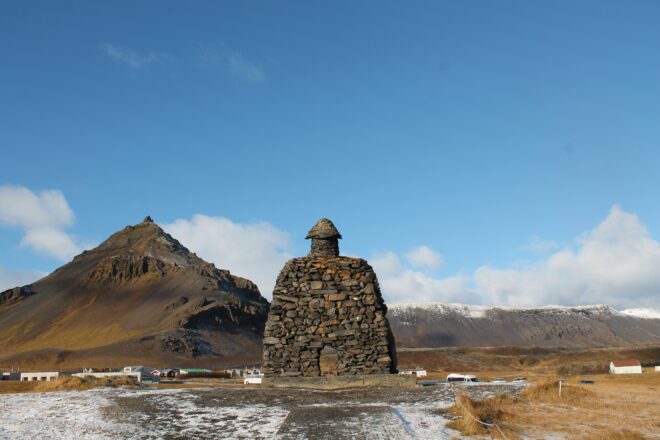
It felt perfect for my 1910 storyline, which already had elements of the supernatural, or magical realism to it (both 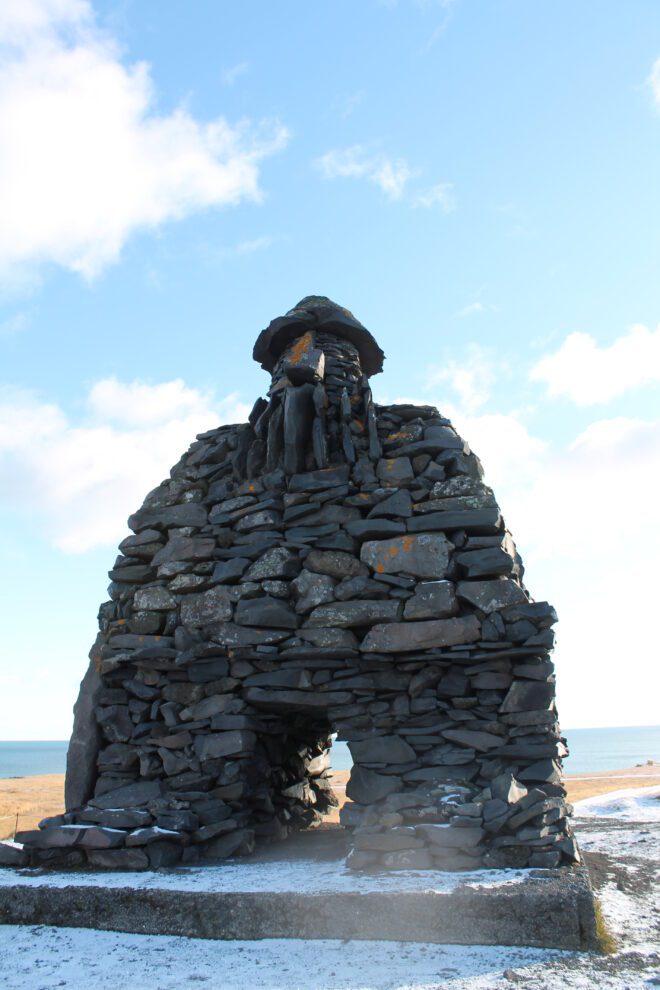 sisters have “abilities” – one can see things that are hidden, and one can see things that haven’t happened yet). It felt even more perfect when I discovered Bárđur, the mythological protector of the region. Part giant, part troll, he came from Norway in the 9th century, and settled the area. As his saga is one of the Islendingsögar (family saga), it occupies a position between fiction and historical record, and so we can learn a lot from it about social relations and values, and about everyday details of common life back then.
Of course, as a saga from the heroic age, there are also more fantastical stories within, and a lot of violence. When Bárđur’s young nephews push his daughter, Helga, onto an ice floe that drifts out to sea, and she is presumed dead, he kills them both, fights with his brother, and disappears into the volcano. He stays there for the rest of the saga, unless called on by his people in the region in their hour of need. He also leaves to retrieve Helga, who didn’t die after all, but floated to Greenland, where she met Skeggi and fell in love. Bárđur, displeased, punishes both: he seduces Skeggi’s daughter from his official marriage, who then gives birth to Gestr, Bárđur’s only son. Helga is charged with raising her half-brother, and kept away from Skeggi, and we hear that she “grieved and faded away ever after”.
Again, this element felt extremely appropriate for one of the themes I’d wanted to look at in my novel, which is the historical male desire for control over female sexuality (and beyond that, even). It felt only right then that the second half of the 1910 storyline take place on the same volcano, Snæfellsjökull, and that Guđrún, one of the sisters, finds herself up there trying to rescue her sister in her hour of need, as Bárđur would the other settlers. It also felt right that she be trapped by a snowstorm and forced to take shelter in an ice cave, much like Bárđur would have had to live in during his self-imposed exile. This cave is purely imagined, as I have yet to climb Snæfellsjökull (although I did visit the peninsula to get a feel for it in person), but it ended up being one of my favourite settings in the book, especially when Guđrún and Magnus leave the cave and witness the Northern Lights. Those I’ve seen in person, and, like so much of Iceland, there’s a real sense of magic to them.
KAT GORDON
Join team TripFiction on Social Media:
Twitter (@TripFiction), Facebook (@TripFiction.Literarywanderlust), YouTube (TripFiction #Literarywanderlust), Instagram (@TripFiction) and Pinterest (@TripFiction) and BlueSky(tripfiction.bsky.social) and Threads (@tripfiction)
 Please wait...