

Thriller set on the ESSEX Coast
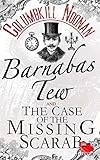
Barnabas Tew and the Case of the Missing Scarab
Location(s): Egypt, London
Genre(s): Mystery
Era(s): Victorian, Ancient Egypt
In “Barnabas Tew and The Case of the Missing Scarab” two well-intentioned but somewhat ineffective detectives, Barnabas and Wilfred, find themselves snatched from their comfortable, if unremarkable, lives in Victorian London to solve a case that threatens all of the Ancient Egyptian underworld, and, by extension, the land of the living as well.
Barnabas and Wilfred idolize Sherlock Holmes and Dr. Watson but sadly cannot live up to the standards set by the famous duo. Together they struggle to make a success of their business but are disheartened by the fact that many of their clients suffer untimely deaths despite their best efforts to prevent such things.
One deceased client, an Egyptian fellow, was impressed with them nevertheless. He recommends them to Anubis, the Egyptian god of the dead, who is in desperate need of a detective. Anubis promptly sends a mummy to dispatch Barnabas and Wilfred (in a frightening and decidedly uncivilized sort of way) so that they might be brought to the Egyptian afterlife (a place filled with tricky gods, a grumpy falcon-headed ferryman, and lots of hungry crocodiles).
Once there, Barnabas and Wilfred learn that Khepre, an enormous scarab beetle responsible for rolling the sun across the sky each day, has disappeared. Suspecting foul play, Anubis asks that the two detectives discover what, exactly, happened to Khepre. Barnabas and Wilfred soon discover that they are in a bit over their heads, as their first suspect, an evil god of chaos, tricks them into accidentally flooding the Nile River. Many people are drowned or eaten by crocodiles in the flood. Anubis is greatly displeased, but allows them to continue on with their investigations. Feeling guilty and inept, the two would-be heroes strive to redeem themselves.
Their efforts are rewarded with varying degrees of success. One of their initial suspects, an unsavory snake-like god named Apep, proves to be more than a match for them, and angrily punishes them for their investigative inquiries by magically changing them into tiny mouse-people. They manage to escape his lair uneaten and discover that the cat goddess Bastet (who quite kindly decides against eating them) shares their dislike of Apep. They convince her to temporarily join forces with them. This leads to a great battle at Apep’s lair, where Bastet and her cats summarily defeat Apep. Much to the detectives chagrin, however, Bastet proceeds to eat Apep before they are able to question him.
The mouse people of the region are thrilled that Apep and his reptilian minions have been eradicated and hail Barnabas and Wilfred as great heroes. It is here that the two detectives begin to feel that they might just be clever enough to succeed. They formulate a plan for how to proceed with their investigation, and set out with renewed optimism.
In their adventures, through a combination of luck and growing confidence in their skills, they manage to narrow down their list of suspects to two disgruntled ancient gods, Anti and Montu, who were displaced centuries ago by the current pantheon.
Knowing that they cannot possibly apprehend the two powerful gods on their own, Barnabas and Wilfred cleverly manipulate Hathor, a feminist goddess with the head of a cow known to fly into the occasional unstoppable rage. They convince her that the two culprits have committed an egregious crime against not only Khepre but also against all woman-kind since the two villains also kidnapped Ma’at, the goddess of justice. Hathor, predictably, is enraged, and helps them to apprehend Anti and Montu. Montu nearly escapes, but Barnabas, to everyone’s surprise (including his own) leaps into harm’s way and takes down the would-be fugitive. Everyone praises his new-found courage. Even Anubis is impressed, so much so that he recommends Barnabas’ and Wilfred’s services to the Viking gods of Norway, thereby setting the stage for their next adventure.
To review this book, please









 Please wait...