Lead Review (plus link to author chat about VENICE)
- Book: Domina
- Location: Belgrade, Paris, St Moritz, Venice
- Author: L S Hilton
3.5*
This is the second outing for the Judith Rashleigh, who first appeared in Maestra, which we reviewed here. There will be a third and final book in the series.
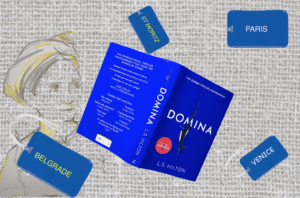 Judith had to abandon her art gallery – Gentileschi – in Paris in the last book for various reasons, and vanish from the art world. She has now popped up in Venice, running a gallery under the assumed persona of Elizabeth Teerlinc, but using the same name Gentilleschi for her gallery (if you are choosing to disappear, surely it isn’t altogether wise to keep the same name….). She has a lovely apartment which she has furnished with ultimate taste. Life could be so good for her….
There is a Caravaggio drawing on linen which a Russian oligarch – Yermolov – wants, and who, at the same time, is determined, it seems to her, to deconstruct her “laboured carapace”, her new identity. She knows that Caravaggio was not known for doing preparatory drawings, so this is more than likely to be a fake. Why would Mr Yermolov crave ownership? Enter his wife Elena who offers a little more clarity into the situation.
Judith’s quest to avoid being found out takes her from beautifully described Venice (comprising the first 1/3 or so of the book) and then on to Paris, Belgrade and St Moritz, locations where the wealthy jetset can be found. Despite her poor beginnings in life, she has insinuated herself into the glitz and glamour of the rich and famous without batting much of an eyelid.
The locations, and in particular Venice, really do come to life – musings on San Teodoro and his anatomically peculiar crocodile at Piazza San Marco (which indeed is a very odd animal) are well observed and that “in every Venetian day there is one moment when the city is made entirely of silver” which is just so true! Some real #literarywanderlust amongst the pages of Domina.
“The end of desire is death” is the mantra throughout and the link between desire and death is strong. Indeed, a visit to Diaghelev’s tomb on the Island of San Michele in Venice leads Judith and Elena to recall the musings of Henry James that “Venice was the most beautiful sepulchre in the world“. Thus, Venice is an apt setting for this tale of life on the edge, a precipice from which many fall.
The book opens with a murder and detailed sex scene and the story moves forward apace from this landmark start.
What are my thoughts? The first book, Maestra, had an ease about it with detailed sex scenes that were certainly eye-watering. In Domina Judith’s character bolts across the pages of the book as she journeys across Europe, picking people up, dropping them, yes, even murdering them. Given that Judith is clearly one of a kind, a bright, calculating and narcissistic personality, it is much harder to connect in this book than it was in the last. It is a brave author who chooses a central character who has sociopathic tendencies.
The author does have a great writing style, the book is intelligent, nattily observed, well researched and L S Hilton can certainly pull together an imaginative story. The cover of this book sums up perfectly the content, and I love the flooded use of the lapis lazuli blue – Ultramarine – the most expensive natural pigment in the art world, used exclusively at one time for colouring the robes of the Madonna in paintings. There is, however, quite some detail in the book about Naples Yellow, the oldest synthetic pigment that dates back to around the 1620s (but *clue* Caravaggio died in 1610, make of that what you will!), so I did wonder whether the cover designers missed a beat by not using what can actually be a rather beautiful yellow on the jacket. But I digress …
Given that I am trained as a psychosexual therapist and have a degree in Art History this book should have really have been a shoo-in. But there is a propensity for page-long details of art provenance and research, and a wealth of designer labels, which could at times bog the storyline down (yes, of course some of it is really interesting, but some of it is really top heavy).
The scenes of a sexual nature are one of the drivers behind this book. As an example, you will find passages like “The tarts were directing operations will all the conviction and enthusiasm of motivational dancers at Hieronymus Bosch’s Bar-Mitzvah, rearing up to shake their hands to the beat before plunging back to insert a tongue or finger into a waiting body”. (The artist Bosch of course was known to be against sensuality and greed – as you can see, I am getting caught up in the artistry!). The often candid liaisons serve to emphasise that Judith is a woman who uses her wiles for her own ends – and for basic survival. Judith struggles however at times to get gratification from all this between-the-sheets activity (or, to be more precise, not so much between-the-sheets as everywhere else), so perhaps there is a sexual dysfunction developing. Now that could make an interesting storyline, but who knows where the author will go with the next instalment. We wait to find out!
This is certainly not a book for everyone. As the author acknowledges, Judith is a flawed character – empowering to some, hated by others.
On this link check out L S Hilton’s top tips for a trip to VENICE
 Please wait...