Lead Review (The Blue Hour)
- Book: The Blue Hour
- Location: The Scottish Borders, West of Scotland
- Author: Paula Hawkins
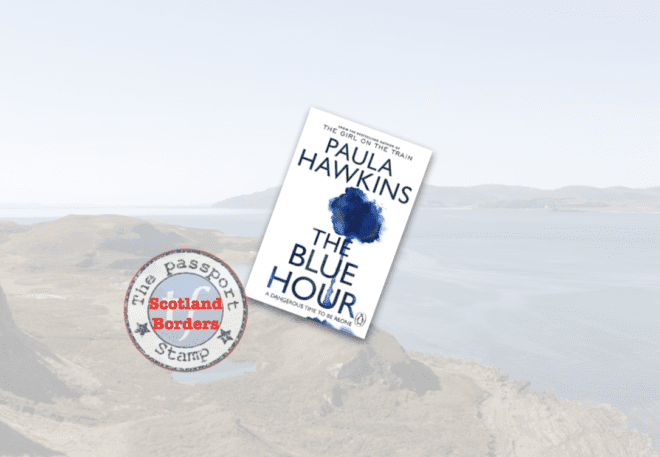
The author certainly feels as though she has definitely regained some of her form in this novel of class, wealth and art connoisseurship, with a mix of precarious psychological instability, tempered with revenge.
At the stately home of Fairburn in the Borders (and yes, I am sure it is meant to be redolent of upper class shenanigans reminiscent of the goings-on in the film Saltburn) Emmeline is the dowager who rules the roost. Her son Sebastian runs the household and supervises the art collection – which comprises mainly the works of the late Vanessa Chapman. To help him curate the artworks, he has engaged his lifelong friend – and Vanessa Chapman devotee and specialist – Becker, who lives in the gamekeeper’s cottage with his wife Helena. Now, pay attention here, because Helena was on the cusp of getting married to Sebastian, when Douglas (his father, Emmeline’s art dealer husband) was shot and killed by mistake. This of course scuppered the nuptials and Helena turned her allegiance from Sebastian to Becker. It was a very ‘adult’ arrangement, Sebastian retreated with his tail between his legs and then put on his brave and stiff upper lip so that the triangle could function. The three now co-exist on the estate but of course these arrangements have a habit of coming unstuck, biting the participants on the bum.
Thus, the convoluted stage is set. Suffice it to say that repressed emotions inevitably need corralling down the line and often manifest in extraordinary ways. The tone of the novel is set in the first few pages when there is a satisfying and credible revelation about one of Chapman’s pieces, on loan from Fairburn to the Tate in London; this certainly made me sit up.
Over on the island of Eris we are given insight through a contemporary and often retrospective lens into the capricious life of artist Vanessa Chapman, by means of diaries which she kept during her artistic years. We learn of the difficult relationship she had with her husband, Julian, who disappeared, and further interchanges between the characters enrich the narrative.
Grace – her long term friend – has made herself at home in the late artist’s home and a deep level of friction between her and the seemingly rightful custodian’s of her art at Fairburn has developed. Douglas, you see, was her art dealer but at one point the two fell out spectacularly and therefore it was a huge surprise that she bequeathed her collection to the foxy folk at Fairburn.
This all sounds complicated – which to some extent it is – but the author is gifted at keeping the lines of the story tight, fluid and intelligible. She has set much of the story on fictional Eris, an island off the West of Scotland that can only be accessed by a causeway twice every 24 hours and therein she already has a dramatic element that she sets to good use. The descriptions are very evocative, as she sweeps around the island, setting her characters up for reflective moments and colourful clashes.
 There is a reasonably good level of psychological intelligence in the way the characters are cast and interact, and how they respond to earlier trauma, with a death or two along the way!
The storyline, I felt, got a little bogged down around 3/4 of the way through when Becker visits Grace on a couple of occasions on the island. The story then came to a juddering end and at first I felt taken aback, but then thought ok, this works well enough, leaving, however, a few untied ends.
I will be really interested to see how this fairly sparky book is picked up generally by readers, given the author’s incredible early success with The Girl On The Train, followed up by a couple of novels that, to my mind, didn’t really have the ingenuity and creative storyline of that success.
This is a readable slow-burn mystery with an atmospheric backdrop.
 Please wait...