Lead Review (The Instrumentalist)
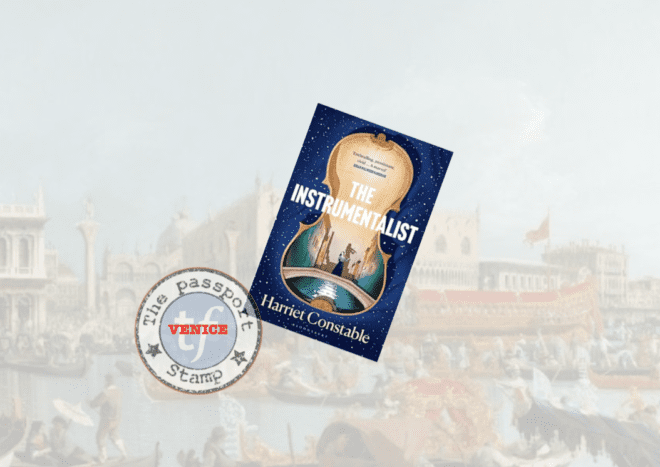
- Book: The Instrumentalist
- Location: Venice
- Author: Harriet Constable
3.5*
In 1696 a baby girl has been posted through the hatch at an orphanage. That baby came to be known as Anna Maria della Pietà, a prodigy who became extremely accomplished at the violin. It is fiction based on the bare outlines of the story of her incredible competency and talent, as she strove for recognition, despite being female and impoverished.
Venice was a city that flourished: this was a time when there was considerable economic and political freedom, and wealthy patrons supported the arts. Thus her appearances were feted and celebrated. However it was very much a man’s world and women were of course subordinate inhabitants, who often unwittingly were at the mercy of the men and their whims. Part of the storyline is her determination to assert herself on the musical stage despite the huge obstacles.
The Maestro, who taught the figlie di coro – the famous orchestra of the pietà (orphanage) – took her under his wing and she was a trusting student, as he drew out her skills and set her to work and study. Her personal ambition was not only to play the violin sublimely but also to compose so that she, too, could become a Maestro (the author in the Author’s Notes stresses that she felt that Anna Maria didn’t necessarily see herself as female but simply as the best, and therefore the author has used the male form of maestro throughout the narrative). “Anna Maria has not her like, in this world or the next… She is the most talented female violinist Venice is yet to produce.” She has a singular drive that invariably took precedence over friendships and life.
This was the Venice of Vivaldi, who had significant involvement in the music of the orphanage and may well have been the Maestro involved in her tutelage. This is her poignant story, as she pits herself against her tutor.
Venice forms a distinct backdrop in the novel, the descriptions have incredible texture and colour: “The lagoon looks like it is alive the next morning. it ripples from slate grey to bark to silver of a coin...” and the sights, sounds and smells of the era are beautifully captured.
The story is set in the present tense, and personally I am not really a convert to that writing style. The present tense serves to give a real sense of immediacy, which adds energy and pace, but as the pages are turned, it can prove a little exhausting to be assaulted by unfolding events in real time. For me it can feel like having the TV tuned into colours that are just a little too bright for a historical story. Devices such as “Now she hears the music…” “Now she is walking into class…” “Now it is the first time she stuck her tongue between her teeth and put note to paper..” are tedious when they are on repeat. Anna Maria is so dedicated to her study, that it can sometimes be difficult to get a sense of her as a flesh and blood girl, although I could appreciate her precocious nature and temperament.
The plight of these young women, who were incredibly disadvantaged and open to all manner of abuse is well laid out is a significant strand in the story. All in all this is a good, poignant and interesting overall read.
The novel is great on Venice and the era in which the story is set and I felt transported to the city of calli, campi and canali. It is already garnering some rave reviews.
 Please wait...