Novel set in CASERTA, CAMPANIA (and LONDON)
Emily Hawkins’ Favourite Lost Kingdoms
23rd October 2022
On this mesmerising quest around the world, prepare to discover lost kingdoms, phantom islands, sunken cities and even legendary continents once sought by explorers but now believed to be mythical. In this special Tiny TripFiction blog post, author Emily Hawkins reveals a few of her favourite vanished places featured in her new extraordinary atlas, An Atlas of Lost Kingdoms.
Let us know in the comments which lost kingdom you’re most intrigued by!
 Atlantis. El Dorado. The Seven Cities of Gold… Since I was young, these place names have spoken to me, as I’m sure they’ve done to generations of children, dreamers, and those hungry for adventure. The words tug at something deep in the psyche – the desire to unravel age-old secrets and mysteries. My thirst for intrigue and excitement was probably the result of watching too many Indiana Jones films – it’s an affliction shared by many! So of course, when I was offered the chance to write this book, An Atlas of Lost Kingdoms, I leaped at it.
This isn’t an ordinary atlas. It’s a guide to lost cities, legendary lands and vanished wonders from around the world. It lays out the facts and stories about each place, trying to untangle the threads of history and myth, separating the real from the make-believe. And it also attempts to put these places on the map, plotting the positions suggested by explorers through the ages. It was fascinating to research these diverse locations and set down their stories. And watching spread after spread of beautifully visualised artwork arrive from illustrator Lauren Baldo added another layer of excitement. Here are a few of my favourite places that we feature – some of them more ‘real’ than others! – along with some edited extracts from the book.
Atlantis
Of course, we have to start in Atlantis. The legend of this sunken kingdom is one of the most enduring stories in the world. Atlantis was first mentioned some 2,500 years ago by Plato, who described a kingdom said to have existed 9,000 years before his time. In his tale, Atlantis was a wealthy island city whose people grew wicked and greedy, so the gods punished them, sending earthquakes to shake the city to its foundations, and enormous waves to drag the remains into the ocean depths.
The story has captivated people for centuries, and some believe that this sunken city was a real place: many locations have been suggested, from the Greek island of Santorini to the Azores islands of the Atlantic. However, most historians agree that Atlantis was dreamed up by Plato as a fable. After all, it’s unlikely such an advanced city could have existed 9,000 years before Plato’s time, when much of the world was still in the Stone Age…
Interestingly, tales of sunken lands have been told in many cultures throughout history, from the Greeks to the Mayans, from the myths of Indigenous Americans to stories from the Solomon Islands. These tales may have been inspired by real places that were submerged by rising waters, or dragged beneath the sea by natural disasters. The ancient Egyptian city of Heracleion, for example, was destroyed by tsunamis, and since the last ice age 20,000 years ago, melting ice has gradually raised sea levels by about 120 metres, meaning that many historic coastal settlements would have been lost beneath the waves. Whatever the truth of the matter, the myth of Atlantis certainly makes a gripping story.

Zerzura
 In the countless legends that swirl around the Sahara Desert, none are quite so intriguing as the story of the Lost Oasis of Zerzura. This is the place that the ‘English Patient’ was searching for in Michael Ondaatje’s novel. It was mentioned in a fifteenth-century Arabic manuscript called The Book of Hidden Pearls: a guide for medieval treasure-hunters, which described a whitewashed city in the desert where great riches were said to lie, along with a sleeping king and queen who should not be woken… It sounds like a fairytale, but in the 1800s an English Egyptologist heard further reports of Zerzura from a local man who had apparently stumbled on the city while looking for a lost camel. He told of ancient ruins surrounded by palm trees, olive groves and bubbling springs of water.
In the 1930s a group of European explorers calling themselves the Zerzura Club scoured the desert by air, intent on finding the lost city – but they discovered no ruins, and no treasure. These days, the Sahara’s great expanse has been explored and mapped from the ground, from the air, and from space, using satellites. Although there are many ruins of abandoned desert towns, no treasure-filled ancient city has been discovered matching Zerzura’s description. But as with many ‘lost’ cities, it’s difficult to prove that Zerzura doesn’t exist. Even if it is just a myth, its legend will no doubt live on – a tantalising mirage tempting anyone with a thirst for adventure.
Troy
The legend of the Trojan War, one of the most famous stories ever told, was set down by Homer about 3,000 years ago. But how much, if any, of the story was based on history? And did the city of Troy really exist? For years, historians thought Troy was just a myth. But in 1871 an amateur archaeologist named Heinrich Schliemann travelled to Turkey to find it. He combed Homer’s writings for clues, then started digging on a grassy mound called Hisarlik. There, he found ancient ruins beneath the ground. Later archaeologists discovered that the mound contained the remains of at least nine different cities, each built on the ruins of the one before. One, known as Troy VII, dates from about 3,200 years ago, which ties it in with the legend.
There’s evidence that this city was protected by mighty stone walls, and archaeologists have found arrowheads, skeletons of people who met grisly ends, and signs of fire damage. There are clues that people once lived cramped together, stockpiling food, lending a grain of truth to the tale of a city under siege. Troy lay in a strategic location at the entrance to the Dardanelles, an important trade route, so it was presumably very wealthy: it would have made a tempting prize indeed. If ever there was a war between Troy and Greece, it was probably fought over power and position – not the love of a beautiful queen!

Port Royal
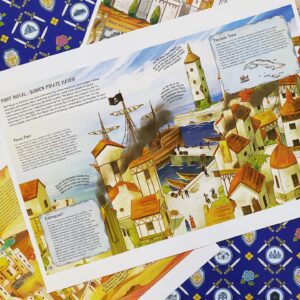 I’m fascinated not only by sunken cities, but also by pirates, so you can see why I find the story of Port Royal so grimly compelling. This wealthy Jamaican port once lay on a key shipping route at the centre of the brutal slave and sugar trade. It was a safe haven for British pirates, who came ashore to spend their ill-gotten gains in the busy dockside taverns. Piracy was against the law, but the authorities here welcomed pirate gold, so they turned a blind eye to their misdeeds. The place was so famous for its marauding visitors that it became known as the ‘wickedest city on earth’. Even the governor, Henry Morgan, had once been a pirate.
But the party didn’t last. On the morning of June 7th, 1692, Port Royal was struck by a catastrophic earthquake. The city stood on a narrow spit of sand with flimsy foundations, so it didn’t stand a chance. Witnesses talked of the ground splitting open, swallowing people and houses. A series of huge waves followed the quake, rolling in and dumping ships on top of buildings, then sucking everything out to sea. Within minutes, 2,000 people were dead and two-thirds of the city’s landmass had been dragged into the ocean.
Today, the ruins of Port Royal lie beneath the waters of Kingston harbour. Underwater archaeologists have salvaged pewter plates, tankards, a chest of silver coins, and a battered pocket watch whose hands were stopped at 11.43 – a ghostly record of the moment the earthquake hit. But the work is slow and difficult, and much of the sunken city remains unexplored. Who knows… perhaps the grave of pirate chief Henry Morgan himself will one day be discovered?
Emily Hawkins
 Once a children’s book editor, Emily Hawkins is now a full-time author. Her work has been featured on the New York Times bestseller list as well as winning the Children’s Travel Book of the Year Award. Along with her background in children’s non-fiction Emily has a strong interest in myth, folklore and storytelling. In 2020 she wrote A Natural History of Fairies, which has been translated into twelve languages, selling more than 100,000 copies worldwide. Emily holds a first-class English degree from Nottingham University, and lives in Winchester, UK.
Catch Emily on Instagram @emilyhawkinsbooks
An Atlas of Lost Kingdoms is published by Wide Eyed Editions, Quarto Kids and is out now!
Join Team TripFiction on Social Media:
Twitter (@TripFiction), Facebook (@TripFiction.Literarywanderlust), YouTube (TripFiction #Literarywanderlust), Instagram (@TripFiction) and Pinterest (@TripFiction)
 Please wait...