
Novel set in the first half of the 20th Century HUNGARY
Novel set in Iran (“the children of the revolution”)
11th May 2015
Children of the Jacaranda Tree, novel set in Iran by Sahar Delijani (plus author Sahar shares a few words with us about life in Iran).
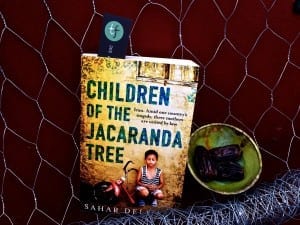 More a collection of essays, this novel introduces the reader to the harsh reality of Iran, post revolution, from 1983 onwards. A large number of characters populate the book, across all ages, and at the beginning there is a list of players detailing who is related to whom.
Evin Prison in Tehran held the political prisoners who had started to make their voices heard in int he country, and follows the lives of various characters up to 2011. From the opening chapter of the book the harsh reality of being confined to prison is scorched on the page. Azar is in the throes of labour, separated from her husband Ismael, and the tortuous birth and conditions are unspeakable. She is supported by one of the political ‘Sisters’ who accompanies her on her journey through labour, and takes every opportunity to humiliate and punish.
The corridors of the prison echo with the slap of sandals and the swish of the chador and those simple noises can instill fear into the assembled prisoners. A tour of the prison takes us to the latrines, to the interrogation rooms and to Ismael, who is making a bracelet out of collected date stones for his newborn daughter. Beyond the prison walls, life goes on, lovers meet, the curfew descends. Some flee to foreign countries for safety and look back on a time of hardship and cruelty. The ripple effect of past atrocities extends into the lives of families right into the 21st Century.
The author states in the book that she wanted to collect the experiences of her own family and make them concrete in written form, but as fiction. It is written from the heart and is an eye opening look at a country in turmoil, where the value of human life had sunk low. In its own way it is a very poignant memoir and a salutary account of human cruelty.
Where it falls down a little is that it feels like separate stories tenuously brought together, and thus it can, at times, lack cohesion. And as the reader opens the book the list of characters, although helpful, feels daunting at the outset and it is all too easy to get caught up in getting the relationships straight. They form the skeleton of the book that supports the flesh of the story.
This is a good and passionate introductory read for anyone who is unfamiliar with this period of Iranian history.
Tina for the TripFiction Team. We asked Sahar about how her own family’s history inspired her novel…

Author : photo from her website
Children of the Jacaranda Tree was inspired as much by stories I had heard from my parents and memories that continued to trickle into the novel as by objects. Everything started with a bracelet of date stones that my father, a political activist fighting against the Islamic Regime, made for me when he saw me for the first time after my birth in Evin Prison in 1983. Then there was a photo of my brother, my cousin and I as children, taken while our parents were in jail and our grandparents were raising us. I wished to tell the story behind this photo, on how these three children and many like them ended up in similar photos, on the tides of life that brought them there together in that moment of history. It is then that the idea of writing about my own birth in prison occurred to me. I realized it was with this birth that everything begins. This birth alone testified to the violent aftermath of a revolution that had promised justice and freedom and instead its consequences were of repression, prison and death, and how these tragic repercussions shaped my generation, the generation born after the revolution. Hence with each object and each story, I wished to speak about a country living under the horrors of tyranny, prison and war, but at the same time tell the stories of the people, who despite everything sought to keep alive their dignity and their humanity even in the darkest and most difficult moments.
You can connect with Sahar via her website
Come and follow Team TripFiction on Social Media: Twitter, Facebook, Pinterest and when we have some interesting photos, we can also be found over on Instagram.
 Please wait...

This book sounds quite captivating, wonderful review 🙂