Novel set in CASERTA, CAMPANIA (and LONDON)
A literary ‘experience’ set in London
2nd December 2022
Suicide Thursday by Will Carver, a literary ‘experience’ set in London.
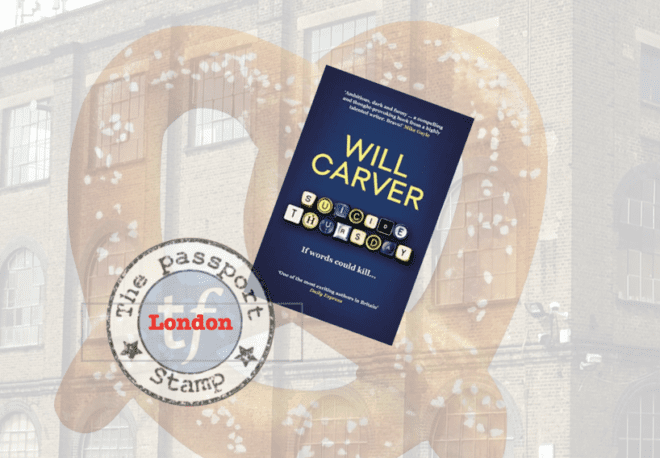
Suicide Thursday is not just a book, it’s an experience! It challenges the reader to consider the differences between truth, lies and fiction using the protagonists own flippant brand of philosophy. It’s not even certain whether it is a crime novel or not until the reader has pieced together the plot. Because Will Carver has written a jigsaw of a book.
It begins with an author, Eli, writing the first chapter of a book describing the narrator’s best friend Mike’s recent suicide. It turns out that Eli has a talent for writing unfinished books – in fact just first chapters – and coincidentally he also has a best friend called Mike. This is where the very blurry lines between fiction and the book’s reality are first made plain to the reader. We realise that not only is Eli an unreliable narrator, he and Will Carver conspire to keep the reader guessing about the plot. The action in the book is misleading in the sleight-of-hand way that magicians beguile their audiences: Eli will narrate a whole chapter in great detail, finally saying, “If this happened.” The reader has to decide whether it did or not.
If all this sounds complicated, it is somewhat. However the storyline and the characters are strong enough and fascinating enough to keep the reader engaged and wanting more. Gradually the pieces of the story are put in place and the full story emerges. There’s also plenty of dark humour to leaven the somewhat grim subject matter. For example, Eli forgives Mike’s incompetence when he first tries to kill himself, saying, “He shouldn’t really have done that, but it was his first attempt.” Eli’s friends are quirky and likeable, such as the endearing Teds, who run the local café, in contrast to his slippery and objectionable colleagues. Overall, this is a fascinating and rewarding read.
Eli is a young man in a temporary job that he hates: he’s afraid of commitment and desperate for a career as a successful author but critically he is unable to finish anything. He can’t resign from his job, end his relationship with the long-suffering Jackie, or finish a second chapter, and he feels helpless to support Mike in his misery. The characters that Eli writes about resemble him in varying degrees and he observes both his own and their inefficacy. He copes with the self-imposed stress of his situation by having counselling sessions with a make-believe therapist. In fact the therapy sessions simply consist of him revealing his inner thoughts in a carefully planned way to himself with the aid of a voice recorder. His impotence is illustrated neatly when we see him, “Almost tapping keys, but withdrawing in disappointment.” Eli quotes Camus’ Sisyphus, and it’s as though he is also condemned forever to repeat his actions, by writing first chapters.
The locations in Suicide Thursday are brilliantly described, evoking all our senses, including such detail as the persistent smell of pretzels in Eli’s former-pretzel-factory home, the fine finish of the newly varnished floor in Mike’s flat and Eli’s unique response to an art exhibition. He reveals the bustle of businessmen in the station, and exactly the number of steps on his commute home, and between home and the neighbouring café. There’s an uncomfortable amount of detail about Mike’s suicide too, but the clue is in the title. Such things are never pretty.
The action is not chronological, but chapters are referred to as X days either before or after the day that Mike will kill himself – as if Eli already has that future event in his diary. (This despite the fact that Mike hesitates to kill himself and certainly has no such date in mind.) Even before news of Mike’s death reaches Eli he says, “Just because it’s suicide Thursday… doesn’t mean I can miss therapy.” We have the benefit of an omniscient narrator who offers us the perspectives of Jackie, Mike and other characters to complement Eli’s own narrative. Several chapters comprise text message exchanges between two unnamed correspondents, one of who wants to kill themself. Again, the reader is left to determine who might be sending the messages. The book reaches a satisfying conclusion, with some clever twists and the feeling that, while nothing in life is ideal, things have worked out the best way they could for Eli under the circumstances. If the short chapters in this book were conventionally arranged it would mean that you could whizz through this book. Happily, the structure means you are forced to take longer and savour the detail, playing detective to discern the truth and the lies. Maybe after all it is a detective novel?
Sue for the TripFiction Team
Follow the author on Twitter
Join Team TripFiction on Social Media:
Twitter (@TripFiction), Facebook (@TripFiction.Literarywanderlust), YouTube (TripFiction #Literarywanderlust), Instagram (@TripFiction) and Pinterest (@TripFiction)
 Please wait...