Murder mystery set in and around Whitstable
Talking Location with author Kim Sherwood – Budapest and Hungary
11th July 2018

Travelling Hungary for the summer. Photo by Kim Sherwood
#TalkingLocationWith…. author Kim Sherwood. She talks to us about Budapest and Hungary, the setting for her novel Testament.
My debut novel, Testament, is about the impact of the Holocaust on three generations of a family, and stretches from Hungary in 1944 to the present day. During the writing of Testament I spent a lot of time in Hungary carrying out research, which allowed me to reconnect with my family’s Budapest roots. I fell in love with the city, and am delighted to share the places and unique cultural calling cards that inspired me.
Water

Széchenyi Baths. Photo by Rosie Sherwood.
Budapest is a city defined by its water, from the stirring swathe of the Danube dividing Buda and Pest, to the natural hot baths. Joseph Silk, one of the main characters in Testament, is a Hungarian artist who arrives to England as a refugee only able to see the colour blue. He is pulled in memory back to the blue waters of his youth.
If you’re visiting Budapest, make sure to visit Széchenyi Baths, where old men are always ready to challenge newcomers to a game of chess, whether it’s sunny or snowing.
To really feel the strength and grace of the Danube, I’d recommend crossing Margit Bridge onto Margit Island, and walking the length of this almond-shaped oasis – you can cool off at Palatinus Strand, a Communist bath – and then crossing Árpad Bridge back onto the mainland. From Árpad you can see both the green fringes of the city and its centre, including Parliament and Buda Castle.
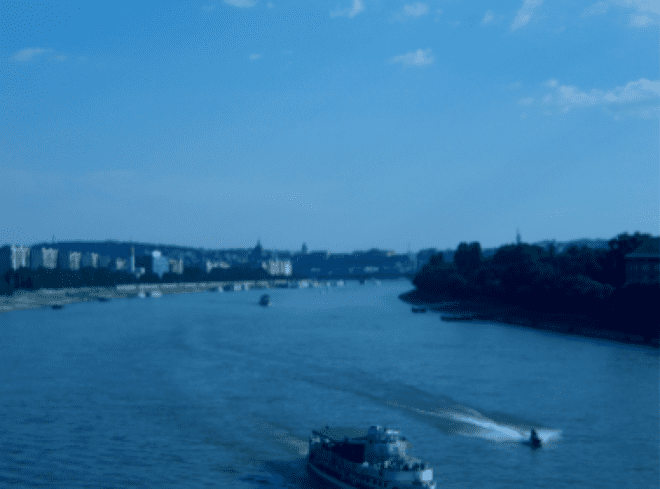
The Danube from Árpad Bridge. Photo by Kim Sherwood
Café Culture

Late night writing at Central Kavéhauz. Photo by Kim Sherwood.
Silk and his brother László both remember their father, a businessman and publisher, drinking coffee and sharing conversation with the other intellectuals of his day. Many Austro-Hungarian cafes survived the Communist years, and it’s well worth seeking them out. My favourite is Central Kavéhauz, where I wrote a lot of Testament, a less touristy spot than the equally beautiful but busy Gerbeaud Café. Central was the haunt of countless Hungarian novelists, poets and philosophers.
If you want to read some Hungarian fiction, my favourite bookshop in Budapest is Irak Boltja, which has a fantastic translation section.
The Jewish Quarter

The mass graves, now a memorial garden. Photo by Rosie Sherwood
The Jewish Quarter has changed in just the six years I’ve been writing Testament, with a DIY arts and food culture bringing new life to an area still known locally as The Ghetto. These streets are where my characters worshipped, played, and grew up. The Jewish Quarter is a mixture of some of the most beautiful sights in Budapest – walk Andrássy ut for the architecture alone – alongside heart-breaking, half-hidden histories. Make sure to visit the Great Synagogue, a stunning mixture of Austro-Hungarian and Moorish styles, and go to the garden, intended as a peaceful site of meditation, and used as a mass grave for 2,281 people, victims of the Arrow Cross (Hungarian fascists). From there, go via Dob utca to Király utca, to see the centre of the Jewish Quarter old and new. You’ll find the last standing remnant of the ghetto wall hidden in an apartment courtyard, and ruin bars where apartment blocks used to stand.
Streets and homes

Street façade. Photo by Rosie Sherwood
If you can, it’s worth staying in an old apartment block, something I did to get a feel for my characters’ childhood homes: the height of a ceiling, how refreshing the shadow of a stairwell is after a hot day. Many of the streets and apartment facades of Budapest are peeling; others still show bullet holes. These walls speak.
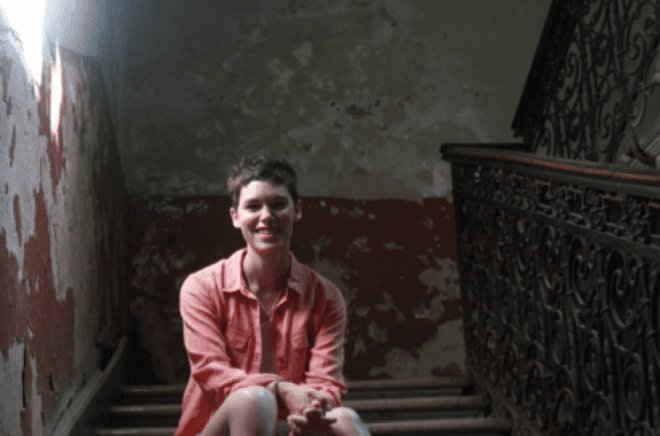
The author’s own façade. Photo by Rosie Sherwood.
Escaping the city
In creating my characters’ childhood memories, I followed them on family holidays and day trips outside of Budapest. It’s worth getting the boat to Szentendre for a day, an old artist’s colony at the Danube Bend, home to the Margit Kovács Ceramic Collection, an extensive yet intimate way to get to know one of Hungary’s leading artists. Home, too, to the smallest synagogue in the world, and the first to be built in Hungary after the Holocaust.
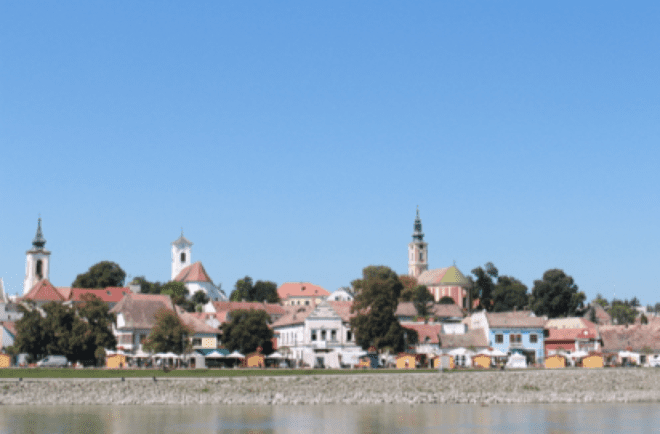
Arriving to Szentendre. Photo by Rosie Sherwood
On the trail of a death march, I took the train to Györ, and then Sopron, two towns in northwest Hungary. One of the most surreal aspects of writing Testament was researching horror while falling in love with architectural and cultural beauty. In Sopron, climb the hills to the Communist cemetery: you are at the very edge of the Austrian border, at the foot of the Alps. The red roofs and town squares below and the dripping firs all around are magical. The ground hides a mass grave where victims of forced labour were buried, and the forest stands in silent testimony to them. Visit the synagogue in Györ, now a cultural centre because the worshippers did not survive to return to it, and marvel at the intricacy of its painted flowers and stars. It’s worth risking the perilous staircase in the Bishop’s Tower in Györ for a bird’s eye view of the blue Danube and brown Raba meeting.
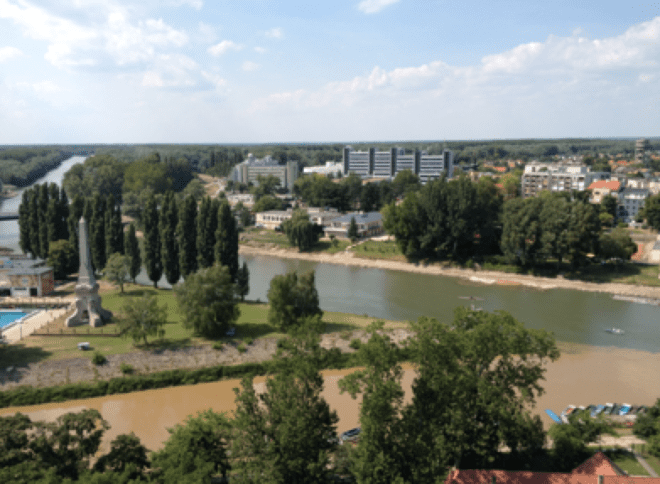
Rivers meet. Photo by Kim Sherwood
I hope you enjoy discovering the history and culture of Hungary in Testament, and that you get to visit this fascinating country. Final tip: if you’re planning a visit to Gellért Baths in Budapest, time it so you cross Szabadság Bridge at sunset, and climb up onto its green girders. There’s nothing so beautiful.
Testament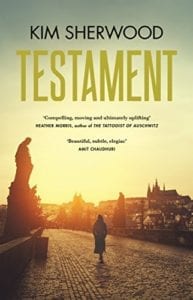 by Kim Sherwood is published by riverrun on 12thJuly
You can follow Kim on Twitter
Do come and join team TripFiction on Social Media:
Twitter (@TripFiction), Facebook (@TripFiction.Literarywanderlust), YouTube (TripFiction #Literarywanderlust), Instagram (@TripFiction) and Pinterest (@TripFiction)
 Please wait...