Novel set in SOUTHERN INDIA in later 20th Century
On the road between the red zones to a Puglia less travelled (Tom Benjamin)
10th March 2020
This is the second piece for TripFiction by author Tom Benjamin from the Covid19 frontline in Italy. Read the first instalment here.
Author Tom Benjamin’s flight across coronavirus-hit Italy toward the ancient wilderness of Gargano and a rough-hewn ‘town of stone’
‘Deserted’ is not usually the first word one would associate with the Italian autostrada, especially in March in mid-morning, or ‘una desolazione’ – literally, ‘a desolation’ – as Ida, my mother-in-law, put it, but we frequently found ourselves alone as we drove along the usually busy three-lane highway en route to Puglia.

The deserted service stations certainly lent to a sense of crisis.
Italians are often seen by outsiders, and themselves, as a disorganised lot but there is at least one exception to this rule – recognised grudgingly by the natives – they are expert at dealing with emergencies. Living on a peninsula wracked by extremes of weather and frequent earthquakes, not to mention a dozen active volcanoes, suddenly all those people you see in uniforms make sense. Italians are accustomed to listening to official advice and acting upon it. And nowhere was that more apparent than on the A14 returning Ida to Apricena, hopefully before it was put under quarantine and no one was permitted in or out.
Never mind the recent government decree to close all schools across Italy, it felt as if the entire nation had gone into voluntary self-isolation. But of course this is nothing new – Italians have been ducking plagues since the time of Boccaccio.
Our race south wasn’t prompted by paranoia – San Marco in Lamis, just twenty kilometres from Apricena, was at risk of being placed in a ‘red zone’, so there was a reasonable chance that nearby towns would also be affected. I was only disappointed that if I wanted to be sure of getting home to Bologna again, I would not be able, as I had initially planned, to stay on for a few days.

The view from a satnav in the quarantine zone – although it indicated all roads were blocked, we had no option other than to continue, which we did without impediment.
But of course – Puglia, what’s not to love? But my Puglia is not the Puglia of trulli, glittering white Ostuni, baroque Lecce, and Primitivo-supping Helen Mirren (the actor owns a home in the region and is habitually pictured standing before some idyllic backdrop looking delighted). My Puglia is in the rather neglected Province of Foggia.
Apricena fringes Gargano – ‘the ‘spur’ on the boot of Italy – a mountainous outcrop covered by one of the nation’s remaining ancient forests before sloping down to beaches frequented mainly, due to their relative inaccessibility, by Italians. My Puglia is a generally grittier place where cacti and wild dogs fringe the roadsides and great manmade mounds of stone sit upon the flat, parched horizon like bleached Mayan pyramids. In fact, as we round the corner above Apricena and are greeted by the church tower with its electric blue cross, that earthy Mexican vibe continues.

A local soaks up the sun in the ‘Citta della Pietra’.
This is the Citta della Pietra – ‘town of stone’. Those great, sun-baked structures have been hewn by the tough, proud folk that live here. It is by no means a tourist town, but then, tourists cannot see the stories – for instance, Apricena used to be known as the ‘Stalingrad of the South’. In a region dominated by forelock-tugging Christian Democrat-supporting peasantry, the Apricenese were unapologetically communist. It is said the reason why the A14 exits at neighbouring hamlet of Poggia Imperiale instead of much larger Apricena is because the right-wing government could not stomach putting the town’s name, literally, on the map.
Archaeologists discovered Europe’s oldest human settlement, dating from well over a million years ago, in the town’s caves, from which the Apricenese have probably been mining marble since the region was part of the Magna Graecia – the ‘Greek World’ – the people who settled here a tribe known as the Dauni, and although I’m no etymologist, my guess is the local dialect sounds like what it is: Ancient Greeks trying to wrap their tongues around Vulgar Latin. Whenever we see a Greek vase in a museum I like to have my wife pose in profile beside it because of the resemblance (I won’t embarrass her with a photo) and when we took my father-in-law to the British Museum, he exclaimed – what are they doing with all our pottery? He had a point – the great majority of vases at the museum appeared to hail from these parts. Meanwhile, in more modern times (216 BC) the Romans suffered their disastrous defeat by Hannibal just down the road at Cannae.
Move into the hills around Apricena and you enter the kind of landscape depicted in Matteo Garrone’s 2015 medieval-set fantasy Tale of Tales. One can easily imagine these wild areas, now populated by long horned cattle and goat herders wandering amid ruined strongholds, as brilliantly evoked by historian Tom Holland in his recent Dominion:
In ancient times pilgrims would make a sacrifice to a black ram before sleeping in its hide… A soothsayer lay buried nearby who, according to Homer, had interpreted the will of Apollo…
But, as Holland traces attempts by Christianity to impose its will, he observes: The danger was particularly acute in a landscape such as the Gargano. Here, where the gods had long been in the habit of haunting dreams, was precisely the kind of wilderness in which they might be expected to have taken refuge.

Gargano’s bewitching beauty.

Where is everyone?
And not only the gods – Italy’s infamous ‘brigands’ also sought sanctuary here following the unification of Italy. Traditionally cast in Italian school history books as mere criminals, they have only recently been acknowledged as resistance fighters against the imposition of the Bourbon state, although in a more sordid contemporary echo, one cannot evoke this historical ‘brigandage’ without acknowledging an on-going feud between local mafia clans that has left more than two dozen dead in recent years.
So the present rides upon the vents of the past like one of the Gargano’s gliding eagles, until down it swoops, talons out. A huge slice of Western civilisation – of human settlement, Greek artistry, Roman and modern history – is rooted here, albeit hidden by an act of planning spite, or so the story goes.
 Meanwhile I receive an urgent call from home – much of Emilia Romagna has been placed in the ‘red zone’ by presidential decree. Bologna, not Apricena, now risks being sealed off. I had better get going.
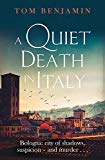
Tom Benjamin’s debut novel A Quiet Death in Italy featuring Bologna-based detective Daniel Leicester, is due out this May and available for pre-order from your chosen bookseller through the TripFiction website. Follow Follow Tom at @tombenjaminsays on Instagram, Twitter and Facebook
Join team TripFiction on Social Media:
Twitter (@TripFiction), Facebook (@TripFiction.Literarywanderlust), (TripFiction #Literarywanderlust), Instagram (@TripFiction) and Pinterest (@TripFiction)
 Please wait...